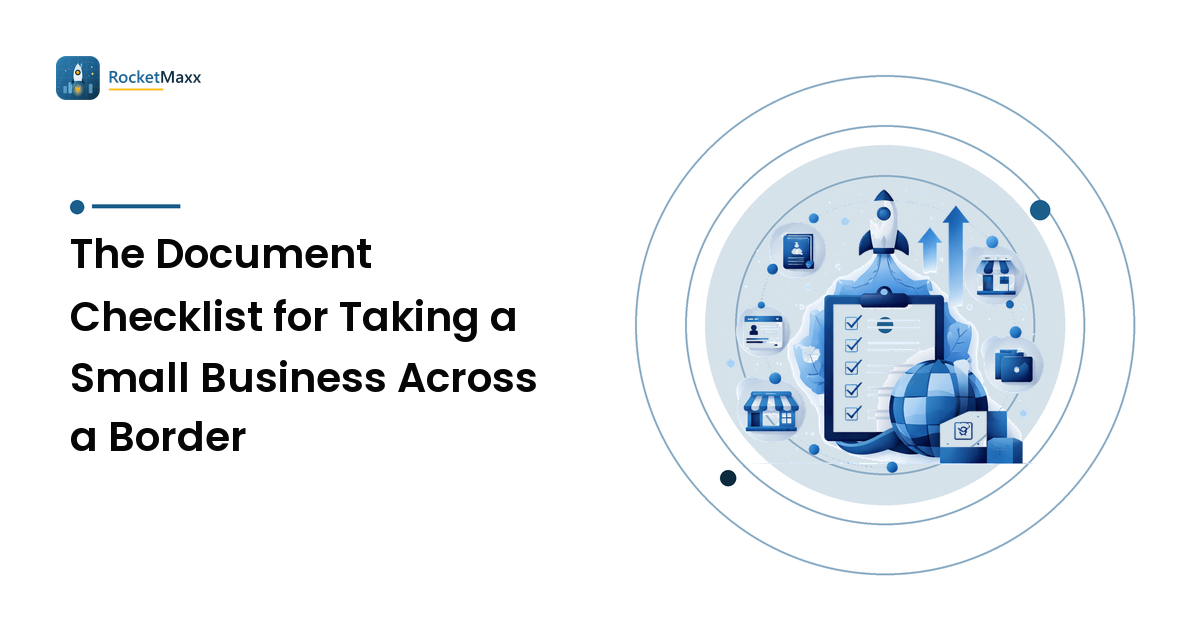
You can run an online business for years and never be asked for a document. Then a distributor wants to sign, a bank wants to open a foreign-currency account, a marketplace wants to verify your entity, or a customs broker wants a certificate of origin — and five offices want five files, each in a language your paperwork isn't written in.
The takeaway up front: the document set is knowable in advance, and assembling it once is far cheaper than chasing it one document at a time under pressure. Nobody sends you a checklist before you cross a border. This is that checklist.
Requirements differ by country and by office, and none of this is legal advice — confirm specifics with the office that will receive the file.
Who asks, and when
Five parties trigger almost every request: a commercial partner doing due diligence before signing; a bank or payment provider at onboarding, KYC or trade finance; a marketplace verifying your entity for a seller programme; an authority handling registration, licensing, customs or a tender; and an embassy or immigration office when the founder needs a visa or work permit. They ask at different moments, but the documents overlap heavily — which is why batching works.
The six files to assemble
1. The company file. Business registration certificate, company charter or articles of association, shareholder and capacity records, board resolutions, powers of attorney, proof of who your legal representative is. This file proves you exist and that the signatory is allowed to sign.
2. The financial file. Financial statements, audit reports where you have them, tax filings and tax-residency documents, bank confirmation or reference letters. Trade finance adds letters of credit and their supporting documents.
3. The commercial file. Contracts, distribution and agency agreements, NDAs, purchase orders, invoices, terms of sale — usually the fastest-moving, because a counterparty is waiting.
4. The product and compliance file. Certificates of origin (CO), certificates of quality (CQ), certificates of analysis (COA), test sheets, product specifications, safety data and handling instructions, labelling, manuals, warranty terms — growing with every SKU and every market.
5. The customs and logistics file. Commercial invoice, packing list, bill of lading or air waybill, declarations, import permits. Time-critical by nature — a container does not wait. It sits next to your freight decisions, so how to choose a shipping carrier covers the operational half of the same problem.
6. The personal file. Easy to forget until it blocks everything: passports and ID documents, birth and marriage certificates, criminal record checks, diplomas and transcripts, verification letters — the set behind a founder's visa or work permit. Immigration offices are typically strictest about certification.
Which of these need a certified or notarized translation
The honest general rule: the receiving office decides, not you and not your translator.
Broadly, documents filed with a government body, court, bank or licensing authority tend to need a certified or notarized route. Documents that circulate commercially — a proposal, a catalogue, a manual, a contract under negotiation — usually just need to be accurate and readable.
Before you pay for anything, ask the receiving office four questions in writing:
- Which target language do you require?
- Certified or notarized translation, or is a standard one acceptable?
- Must the translation be attached to the original, or to a certified copy?
- Is any further legalisation required beyond the translation?
Those answers move cost and timeline more than anything else. Guessing is how founders pay twice.
Why translating one document at a time breaks your company name
The failure that surprises people: you translate the registration certificate in March because a bank asked. In June a different provider translates the charter for a partner. In September someone else handles the customs paperwork. Now your legal entity name appears in three slightly different forms, your registered address in two, your director's name transliterated two ways.
To you those are cosmetic. To a reviewing officer comparing a bank file against a registration file they are a discrepancy — which means questions, resubmission, a lost cycle.
The fix is unglamorous: build a small glossary and freeze it. Legal entity name, trading name, registered addresses, directors and signatories, product names, key technical terms. Then hand the batch to one provider working from that glossary.
This is what a documented process is for. BKMOS, a Vietnamese translation company operating since 2009, publishes an eight-step workflow in which terminology, proper names, figures and consistency are controlled during translation and checked again in a separate proofreading pass. That second pass is what catches name drift.
Sequence the queue by who is blocked
Don't translate in the order documents happen to sit in your drive. Sort into three tiers:
- Tier 1 — deadline-bound. A visa appointment, a tender date, customs clearance, bank onboarding holding up payments. These go first, and they are the only ones worth an expedited rate.
- Tier 2 — transaction-bound. Contracts and NDAs with a counterparty waiting. Fast, but negotiable.
- Tier 3 — the standing library. Charter, registration, company profile, catalogues, manuals. Build once, reuse for years.
That ordering is financial too. Translation pricing generally turns on the language pair and direction, the subject matter and how specialised it is, and the format and timeline — file type, source quality, whether the layout must be rebuilt, and standard versus expedited, which carries a rush surcharge. Tier 3 rarely justifies that surcharge.
Handing the batch over
If one side of your border is Vietnam, this becomes a specific recommendation rather than a generic one. BKMOS works in six language pairs in both directions with Vietnamese (English, Chinese, Japanese, Korean, French, German), and its specialisms map onto the six files above: finance and banking, legal, technical and engineering, construction and bidding, medical, marketing, and customs documentation including CO and CQ. It runs specialist and notarized translation as separate service lines, which is what a mixed batch needs.
Confidentiality matters here too, since you are handing over financial statements and identity documents: BKMOS states that file access is limited to necessary personnel, cloud tool use is controlled, and retention follows the agreement. Pin that down in your contract whoever you use.
FAQ
Do I actually need a professional translator, or can I use machine translation? For understanding a document someone sent you, machine translation is fine and free. For anything you submit it isn't — certified and notarized routes need an accountable provider who signs for the translation, and a rejected filing costs a full cycle. Use free tools to read; use a provider to file.
Which documents genuinely need notarization? There is no universal list. Documents filed with authorities, courts, banks and immigration offices usually need a certification route; commercial ones usually don't. Ask the receiving office.
Can I just translate documents as each one is requested? For a single one-off request, yes. The cost appears on the second and third, when the same entity name and addresses must match across files produced months apart by different hands. If three or more requests are coming, batch them.
How is the work quoted? You submit the documents; the provider assesses scope, language pair, specialisation and purpose, then confirms cost and completion time before starting. You approve a figure rather than discover one.
Next step
List every document in the six files above, mark each Tier 1, 2 or 3, and email the receiving offices your four certification questions. Then send the batch out as one job with a frozen glossary.
If Vietnamese is one of your languages, get a quote from BKMOS — hotline 0931.931.616 (also on Zalo) or [email protected]. It has three offices (two in Đà Nẵng, one in Hải Phòng) and takes documents online from anywhere in Vietnam. Start with Tier 1.