Launches rarely fail because the theme looked wrong. They fail because a path nobody walked end-to-end was broken on day one — a payment method that wasn't switched out of test mode, a confirmation email landing in spam, an analytics tag that never fired, a shipping rate that quietly charged nothing. The traffic arrives, the orders don't, and you spend a week guessing.
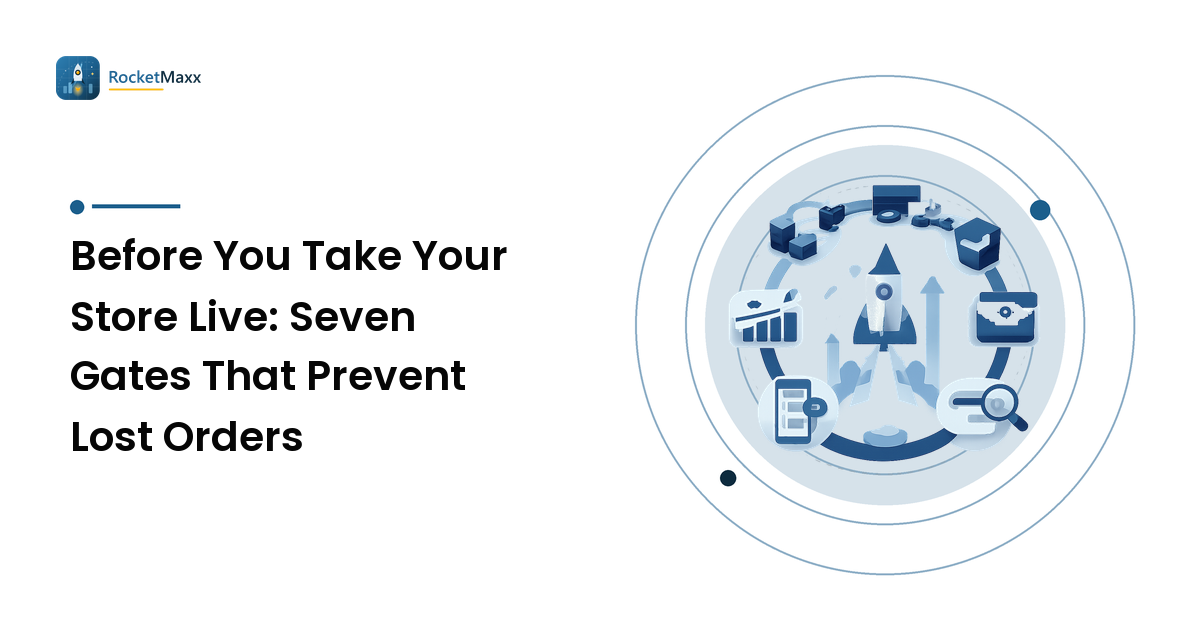
The fix is to treat pre-launch as pass/fail gates rather than a to-do list, and to pass each gate by completing the action as a stranger would — not by looking at the setting and deciding it seems fine. A checkbox in an admin panel is a claim. A completed test order with a real card is proof. Work the seven gates below in order; each one blocks the next, because there is no point optimizing a product page if the checkout can't take money.
How to use these gates
Every gate has a pass condition written as an action, not a state. If you can't perform the action and observe the result, the gate hasn't passed. Two rules make it work: use a second identity (a different browser profile, a different email address, a phone that isn't logged into your admin — your own session hides half of what a new visitor experiences), and never fix and assume (after any fix, run the action again; most launch-day disasters are fixes that were never re-tested).
This assumes the earlier decisions — model, product, platform — are made. If they aren't, start with the step-by-step guide to starting an online business and the platform buying guide, then come back to verify what you built.
Gate 1 — The money path
Pass condition: you have placed a real order with a real payment method, on the live site, and the money reached your account.
Test mode is the number-one silent killer: a store can look completely functional while every transaction is a sandbox transaction. Switch payments to live, buy something yourself at full price, then refund it. Along the way, confirm:
- The order appears in your admin with the correct total, currency, and customer details, and the payout destination is your real, verified account rather than a placeholder.
- A declined card produces a clear, recoverable error, not a blank page. Some share of real cards will decline; what the buyer sees decides whether they retry or leave.
- Every payment method you display actually completes. If you show a wallet or a buy-now-pay-later button, test that button specifically — displaying an untested method is worse than not offering it.
- Tax settings are configured deliberately rather than left at default. Sales tax, VAT, and equivalent obligations depend on where you operate and where your buyers are, and getting them wrong is expensive to unwind — treat this as a question for a qualified accountant or tax professional in your jurisdiction, not something to settle from a help article.
Gate 2 — The delivery promise
Pass condition: the thing you sold arrived, and the buyer was told it was coming.
For physical goods, order to a real address and check that the shipping rate charged matches what fulfilment actually costs you — a misconfigured rate that charges zero on heavy items turns every sale into a loss. Confirm the delivery estimate at checkout is one you can meet, and that the regions you ship to are the only regions that can check out. For digital goods, the download or access link must work from a fresh browser with no session — click it exactly as a buyer would, not from your admin.
Then check the emails. The order confirmation is the most-opened message your store will ever send, and it fails in mundane ways: it never sends, it comes from an unauthenticated domain and lands in spam, or it still contains template placeholder text. Send a test order to a webmail account whose reputation you don't control, and check the spam folder, not just the inbox.
Gate 3 — The trust surface
Pass condition: a stranger can answer "who am I buying from, and what happens if this goes wrong?" without leaving the site.
Uncertainty at checkout costs more orders than design ever will. Before launch:
- Shipping, returns, and privacy pages exist and say something specific. "30 days, buyer pays return postage" beats a generic template nobody wrote.
- A contact route reaches a human. Send a message through your own form and confirm it arrives somewhere you'll see.
- The site is served over HTTPS with no browser warning, on every page including checkout.
- Product pages answer the obvious questions — size, materials, what's included, what happens after purchase. Every unanswered question is a reason to close the tab.
Gate 4 — The capture path
Pass condition: a visitor who leaves without buying has given you a way to reach them, and something automatic happens next.
This is the gate most first launches skip, and the one with the longest tail. Almost everyone who visits in week one will not buy in week one; without capture, that traffic is spent and gone.
Have three things live before launch: an email capture with a reason to sign up that isn't "join our newsletter", a welcome message that sends automatically and does more than say hello, and an abandoned-cart reminder armed and tested. Place a test order, abandon it at the payment step, and confirm the reminder actually arrives — doing that without irritating people is covered in our guide to recovering abandoned carts. Choose the platform that runs this before launch rather than after; migrating a list and rebuilding automations later is work you'll resent.
Gate 5 — The measurement path
Pass condition: your test order shows up in analytics as a completed purchase, attributed to the source you arrived from.
You cannot diagnose a launch you didn't record. After the test purchase, verify the purchase event fired with the right value, then check:
- Traffic source is recorded. Visit from a link with campaign parameters and confirm the attribution, or every channel decision you make later is a guess.
- Your own visits are excluded or identifiable, so week one's numbers aren't mostly you.
- You can produce four numbers on demand: sessions, add-to-carts, checkouts started, orders. Without them you can't tell whether a problem is traffic, interest, or checkout.
Gate 6 — The phone pass
Pass condition: you completed a purchase on a real phone, on cellular data, without pinching to zoom.
Not a desktop browser resized — an actual phone, off wi-fi, so you feel the load time a real visitor feels. Walk the whole path: land, browse, add to cart, check out, pay. Watch for what breaks only on mobile: fields that trigger the wrong keyboard, a discount box that shoves the pay button off screen, a popup with an unreachable close button, images so heavy the first screen crawls. If any step makes you sigh, a stranger with no investment in your store is already gone.
Gate 7 — The findability minimum
Pass condition: your key pages can be indexed, and the words on them describe what you sell.
You don't need an SEO programme before launch. You need to not be invisible by accident:
- Remove the "discourage search engines" setting that most platforms enable on unpublished stores. Shipping with that flag still on is the most common launch-day own goal.
- Every important page has a unique title and description that names the product in the words a buyer would use.
- A sitemap exists and is submitted to search console tools.
- One canonical domain. Pick
wwwor non-www, redirect the other, and use the same one in every link you publish.
What can wait until after launch
Deliberately, so you actually launch: a blog, a loyalty programme, a second payment provider, custom design work, a full product catalogue, translations, and any automation that saves ten minutes a month. None of these decide whether your first week works. The seven gates do.
The rehearsal
Before you spend anything on traffic, do one full dry run in a single sitting: click a link with campaign parameters from your phone, browse as a stranger, add to cart, abandon it, wait for the recovery email, return, complete the purchase with a real card, receive the confirmation, receive the product or access, then refund yourself. Write down every moment of friction as it happens.
That rehearsal takes under an hour and finds more real problems than a week of design tweaks — because it's the only test that exercises every system you just built, in the order your customer will.
FAQ
How long should pre-launch checks take?
An afternoon for the gates, plus whatever fixing they surface. If you're spending weeks, you're polishing rather than verifying. The gates test whether the store functions; taste-level improvements are launch-week work, not launch-blockers.
What's the most common thing people miss?
Payments left in test mode and confirmation emails landing in spam — both invisible from the admin panel, both fatal on day one. Right behind them: analytics that never recorded a purchase, so the founder can't tell whether the problem is traffic or checkout.
Do I need to sort out business registration and taxes before launching?
You need to have made a deliberate decision rather than defaulting into one, and the specifics depend entirely on your country, your structure, and where your customers are. Talk to a qualified accountant or business adviser in your jurisdiction before you take money — this is one of the few areas where guessing is genuinely expensive.
Is it worth setting up email before I have any traffic?
Yes, and it's the highest-leverage item on this list. Every visitor who arrives before capture is live is an audience you can never contact again. It's the one gate whose cost of being late is unrecoverable.
Next step
Block out an afternoon and run the seven gates in order, using a second identity and a real card. Fix what fails, re-run the gate, and only then buy your first click. The store that survives its own launch week isn't the prettiest one — it's the one where every path from click to delivery was walked by a human before a customer had to.
Gate four is the one to get right before launch day: when you're choosing the platform that will run your capture, welcome sequence, and cart recovery, compare the best email marketing tools on RocketMaxx and pick the one that fits the store you're launching, not the one you might have in three years.